
Most founders plan their exit far too late. Here is what buyer-side experience reveals about the problem — and why the clock starts earlier than you think.
There is a pattern that shows up consistently when you look at owner-led businesses from the outside.
The financials suggest a certain value.
The operations tell a different story.
Having had the opportunity to look at a number of businesses from the buyer’s perspective, the single most common factor that quietly deflates what a business is worth is not weak revenue or thin margins.
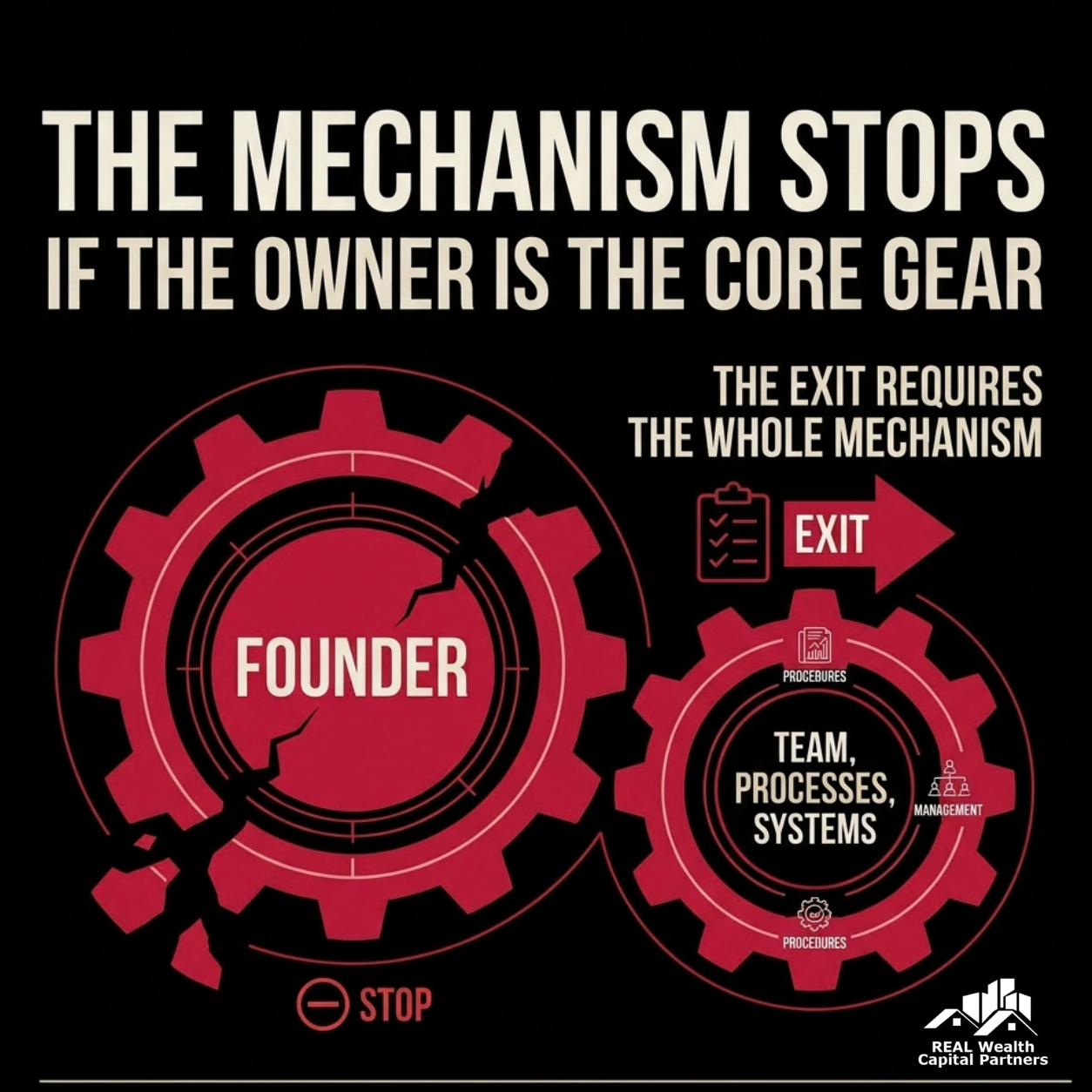
It is that the business cannot function without its founder.
The owner is in every client conversation. The owner holds the institutional knowledge that keeps the work moving. The owner is, effectively, the product.
Take that person out of the equation, and the business shrinks or stops.
Buyers see that clearly.
And they price it accordingly.
A business that cannot operate without its owner is not being valued as a business. It is being valued as a job — and buyers price it accordingly.
What This Actually Does to Your Valuation
When a buyer evaluates a business, they are not purchasing your past revenue.
They are purchasing confidence — specifically, confidence that the revenue will continue after they take ownership.
If that confidence depends on you remaining present, the math changes significantly.
This shows up in two concrete ways.
First, buyers apply a higher risk discount to the purchase price, which means a lower multiple on your EBITDA. A business that commands a five-times multiple in a clean sale might get offered three-times when the buyer identifies meaningful owner dependency.
On a business generating $500,000 in EBITDA, that is a $1,000,000 difference.
Second, buyers often require longer earnout periods to protect the transition.
The headline number may look attractive, but the structure ties you to the business for two or three years post-sale at a lower guaranteed payment.
The exit you planned becomes a delayed one.
The businesses that sell well — quickly, cleanly, at strong multiples — share one characteristic.
They are built to run without the founder in the room.
Revenue is not concentrated in one person’s relationships.
Financial reporting is clear and current.
Processes are documented and followed by the team.
There is a management layer that can answer a buyer’s due diligence questions without the owner on every call.
That does not happen in six months.
It is the result of deliberate work done years in advance.
The Mindset Shift That Has to Happen First
Most founders think about exit planning as something they will do when they are ready to leave.
That framing is exactly what costs them.
The right framing is this:
The work you do to prepare your business for a sale is the same work that makes it more profitable and easier to operate in the meantime.
Removing yourself from the day-to-day does not weaken the business.
It strengthens it.
A business that can operate without you is a business that scales.
It attracts better clients, better employees, and better offers.
Exit readiness is not an end-of-career project. It is a way of building.
The owners who get the best outcomes are not the ones who started preparing when they were ready to leave.
They are the ones who built with the end in mind from the beginning.
Next Week in Part 2
The practical framework — what to build, in what order, and how far in advance — along with the five specific areas that consistently move the needle on what a buyer will pay.
Elizabeth Carrera, CPA
Fractional CFO | Real Wealth Capital Partners Inc.
elizabeth.carrera@realwealthcp.com | realwealthcp.com