
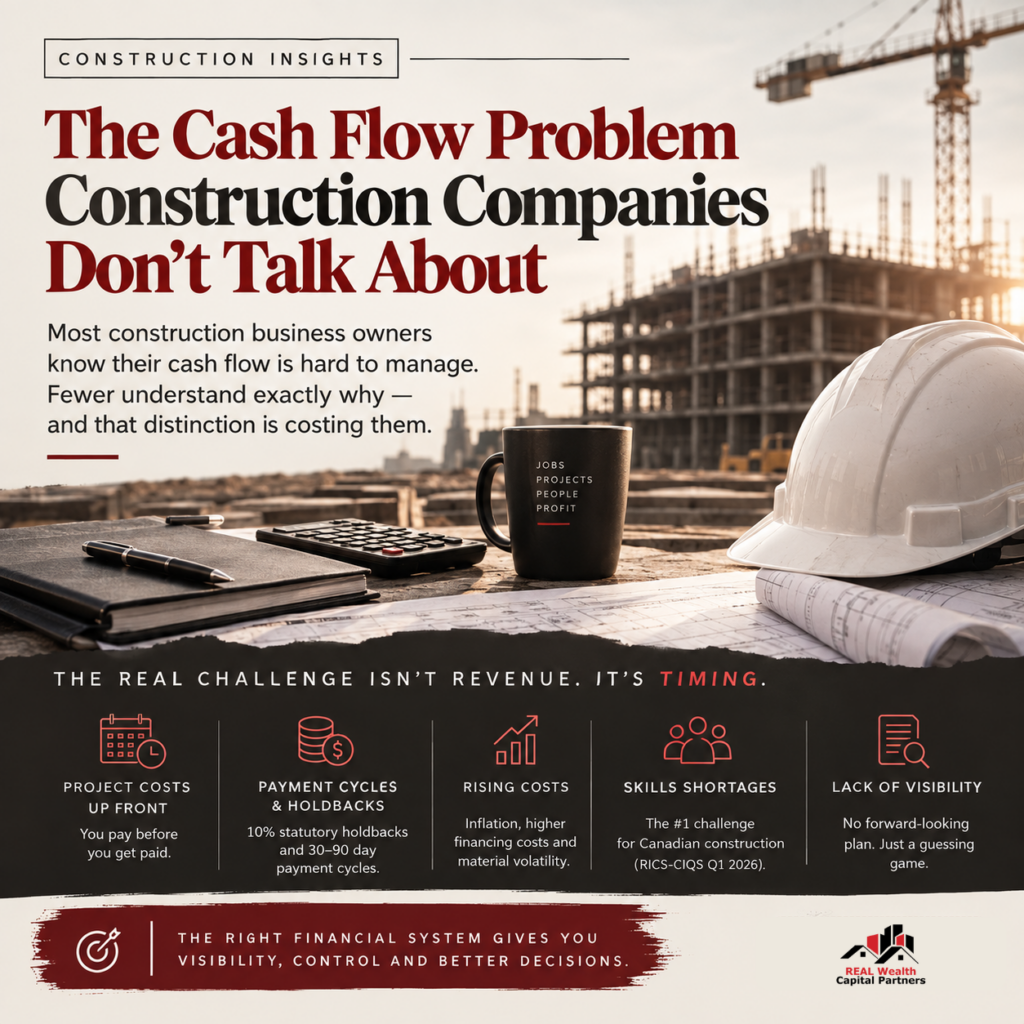
Most construction business owners know their cash flow is hard to manage. Fewer understand exactly why — and that distinction is costing them.
If you run a construction company, you have probably experienced some version of this: a strong year on paper, solid revenue, contracts signed, work completed — and somehow you are still watching your bank account more nervously than you should be.
That is the frustrating reality of construction cash flow problems: the business can look healthy while the cash tells a very different story.
It is not necessarily a sign that something is wrong with your business. It is a structural reality of how construction gets paid. And most owner-operators are managing it with a combination of gut instinct, a bookkeeper, and a QuickBooks balance they half-trust.
That is not a financial system. It is a guessing game with high stakes.
The Real Problem Is Timing, Not Revenue
Construction cash flow is not difficult because companies are necessarily unprofitable. It is difficult because there is a fundamental mismatch between when the work happens and when the money arrives.
You mobilize crews, purchase materials, and carry subcontractor costs well before a progress payment lands. In Canada, you are also working around 10% statutory holdbacks on many contracts — money you have earned but cannot touch until the applicable holdback release conditions are met, sometimes months after the work is complete.
Add 30- to 90-day payment cycles on top of that, and you are routinely financing your clients’ projects with your own cash.
The question is not whether your business is cash flow positive. The question is whether you can see the gap coming far enough in advance to do something about it.
Most construction owners find out about a cash flow problem when their bank balance drops. By then, the options available to them are limited and expensive.
A line of credit gets drawn. A supplier payment gets delayed. A subcontractor relationship gets strained.
The underlying issue — no forward visibility — stays exactly where it was.
What the Data Is Telling Us Right Now
The pressure on Canadian construction companies is not easing.
According to the RICS-CIQS Q1 2026 Canada Construction Monitor, skills shortages were the most widely cited challenge for the second consecutive quarter, while inflation remained a significant obstacle for construction firms.
Financing conditions also remain an important consideration. As of September 2026, the Bank of Canada’s overnight rate is 2.25%, while the major banks’ posted prime rate is 4.45%. For construction companies managing working capital, equipment purchases, and project financing, the cost and availability of capital still matter.
Earlier this year, a report from the UK construction sector noted that 88 construction companies entered administration in the first six months of 2026 alone, an 11% increase over the prior year. The specific triggers vary, but the underlying pattern is consistent across markets: margin compression combined with poor cash flow visibility can create significant pressure for owner-operated construction businesses.
Canada is not immune to that pattern.
What a Real Financial System Looks Like
There is a meaningful difference between having a bookkeeper and having financial clarity.
A bookkeeper ensures your records are accurate and your taxes are filed. That is essential. But it does not necessarily give you a forward-looking picture of your business.
A financial system built for a construction company does several things that bookkeeping alone cannot:
- Rolling cash flow forecast. A 13-week rolling forecast updated regularly tells you where your cash position is heading, not where it was last month. That visibility allows you to make decisions on hiring, new contracts, equipment purchases, and other commitments without flying blind.
- Project-level profitability. Knowing your total revenue is not the same as knowing which contracts are making you money. Project-level margin tracking tells you where you are profitable, where you are getting squeezed, and where your estimating assumptions need to be revisited.
- A decision framework for growth. When you are considering a new contract, a key hire, or an equipment purchase, the question should not be answered by gut feel or a quick look at your account balance. A financial framework gives you the numbers behind the decision before you make it.
- Documented workflows. If the financial knowledge of your business lives in your head, that is a risk. Documented financial processes reduce key-person dependency and are a foundational requirement for any future sale or refinancing event.
The Gap Most Construction Companies Are Living In
The construction companies that struggle most financially are not necessarily the ones without revenue. They are often the ones operating in the gap between their bookkeeper and a full-time CFO.
They have outgrown a purely transactional financial function but are not at the scale where a six-figure salary hire makes sense.
That gap has a solution.
A Fractional CFO provides the strategic financial leadership of a senior finance executive without the full-time cost. For a construction company managing multiple contracts, a Florida expansion, or a push toward a five-year exit, that level of financial oversight can provide the visibility needed to make decisions with greater clarity.
You have built a real business. It deserves a financial system that can keep up with it.
A Final Thought
Cash flow problems in construction are not necessarily a sign of a bad business. They are a structural feature of how the industry works.
The owners who navigate them well have better visibility into what is coming and a system for making decisions before the pressure arrives.
Want to Know Where Your Cash Flow Actually Stands?
If you are running a construction company in Ontario and want to understand what your financial picture actually looks like — and where the pressure points may be — let’s talk.
At Real Wealth Capital Partners, I help construction business owners build the financial visibility they need to make better decisions around cash flow, profitability, growth, and long-term planning.
You have built a real business. It deserves a financial system that can keep up with it.
Take the Financial Blind Spot Score →
It takes just a few minutes and gives you a clearer picture of where your business stands across five areas of financial visibility.