
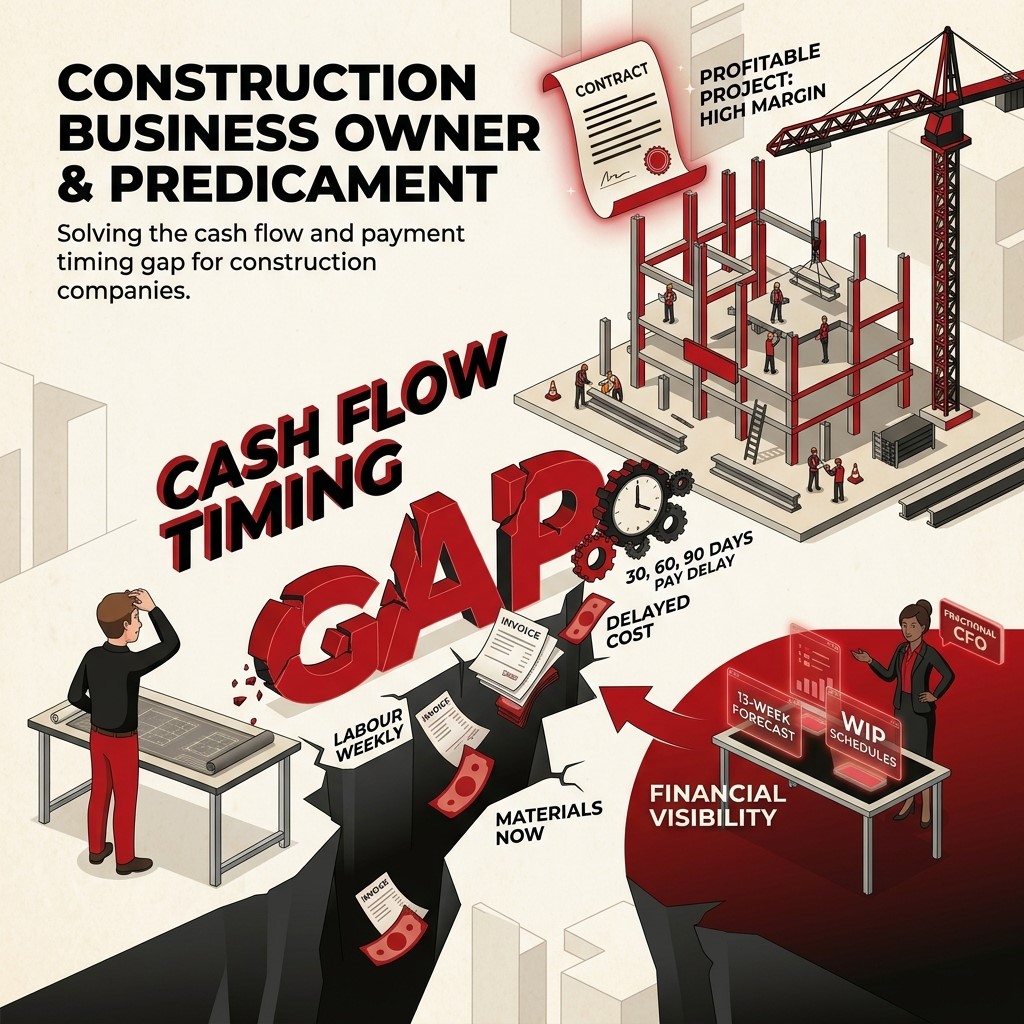
Most construction owners have passed on profitable contracts because of cash flow timing. Here is what that pattern is actually costing you.
There is a particular kind of frustration that construction business owners describe when they talk about growth: not the jobs they lost to a competitor, but the jobs they never bid on because they already knew the answer.
The work was real. The margin was there. The capacity existed. But the cash to front labour, materials, and subcontractors before any invoice got paid was not. So the decision got made before it ever became a decision.
New data puts a number on this pattern. According to a 2026 industry survey, 90% of senior construction decision-makers have passed on a profitable project because of cash flow timing. Nearly half have done so multiple times. And 100% report that cash flow influences whether their company pursues or declines work, with more than half saying it acts as a constant filter.
This is not a small business problem. It is an industry-structural problem. And it has a financial solution that most construction companies are not using.
The Construction Cash Cycle Is Not Like Other Industries
Construction businesses operate on a delayed payment model by design. Labour gets paid weekly. Materials get invoiced immediately. Subcontractors expect payment on schedule. But the general contractor waits 30, 60, sometimes 90 days after completing work to receive payment, with a portion held back as retainage on top of that.
Even profitable projects create cash pressure. The business makes money over the life of the contract. But in the middle of that contract, it is carrying significant costs against receivables it has not collected yet.
The result is a company that looks healthy on paper but feels permanently tight. When a new opportunity arrives, the question is never really “can we do this work?” It is “can we fund the gap between now and getting paid?”
What Most Construction Owners Are Missing
The gap is not insurmountable. But closing it requires a level of financial visibility that most construction companies do not have in place.
Specific tools make a material difference: a rolling 13-week cash flow forecast that shows the exact timing of cash in and cash out; work-in-progress schedules that track project margin in real time rather than at contract close; tight change-order documentation that protects margin as scope shifts; and accounts receivable discipline that shortens the collection window wherever possible.
These are not complicated concepts. They are financial systems that have been standard practice in larger capital-intensive organizations for decades. The gap is that most construction businesses do not have anyone responsible for putting them in place or maintaining them under pressure.
The Role That Changes the Equation
A full-time CFO costs $220,000 to $350,000 per year in total compensation. For a construction company doing $3M to $15M in revenue, that hire is neither practical nor necessary. But the financial function that person would provide, forward-looking cash visibility, project-level margin tracking, capital planning, is exactly what these businesses need.
This is the space a Fractional CFO fills. A senior finance professional with experience in capital-intensive operations, working alongside the business owner at a fraction of the cost. Not bookkeeping. Not tax prep. Strategic financial management applied to the specific cash cycle and risk profile of construction.
I am a CPA with 15 years in Financial Planning & Analysis, Budgeting, and Financial Reporting at complex organizations, including time with KPMG. I also deploy capital across real estate acquisitions, which means I understand what it feels like to make high-stakes decisions without a clear forward-looking financial picture. That combination is what I bring to the construction companies I work with.
The Work Is There
The construction market in 2026 is not without opportunity. Demand exists. Skilled operators are well-positioned to grow. The constraint for most owner-led businesses is not the pipeline. It is the financial infrastructure to support it.
If you are passing on profitable work because of cash flow timing, that is not a capacity problem. It is a financial visibility problem, and it is one worth solving.
If you would like to explore what a Fractional CFO engagement could look like for your business, I am happy to start that conversation. Reach me at elizabeth.carrera@realwealthcp.com.